
Blog
Daycare & Preschool Playground Equipment: A Buyer’s Guide to Safety, Age-Grading & Design
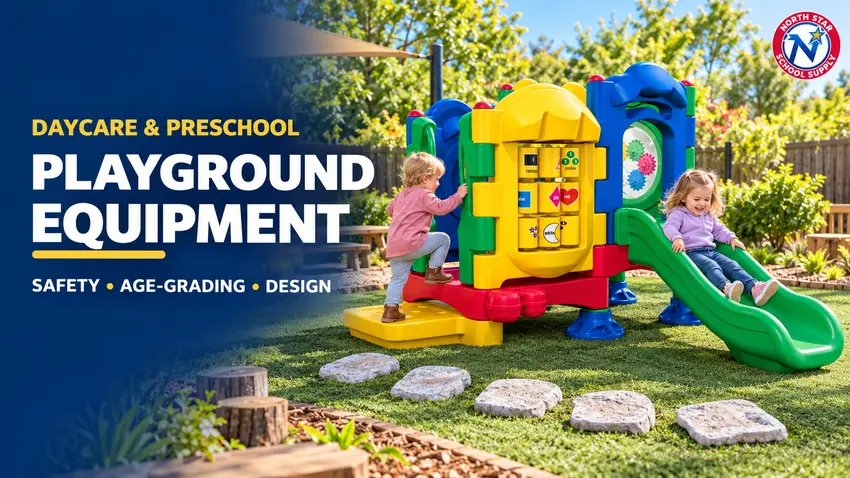
Preschool playground equipment must be selected differently from equipment designed for a public park. The age range is narrower, the safety standards are stricter, and every piece should support specific developmental skills while making efficient use of limited play space. This guide explains what to check before buying, how to choose age-appropriate equipment for children ages 2–5, and where natural and loose-parts play fits alongside fixed structures.
This buyer’s guide complements our zone-by-zone outdoor learning environment guide, which explains how to organize gross-motor, sensory, dramatic-play, quiet and transition areas within the same outdoor space.
What Makes Playground Equipment “Preschool-Grade”
Preschool and daycare playground equipment is graded for a narrower, younger age range (typically 2-to-5 or 6-to-23 months for infant/toddler-specific equipment) than general public playground equipment, with lower step heights, shorter platforms, and tighter fall-zone requirements. Equipment rated for a 5-to-12 age range doesn’t meet safety expectations for a mixed toddler-to-pre-K group even when it physically fits the available space — age-grading is a safety spec, not a marketing category.
For infant and toddler play areas, choose equipment designed specifically for children under two. For example, the Seedling Playground is designed for ages 6–23 months and uses lower platforms, handrails and age-appropriate interactive activities.
What to Check Before You Buy
- Age-grading certification. Confirm the manufacturer’s stated age range matches your actual enrolled age range, not just your available footprint.
- Fall-zone surfacing requirements. Every piece of equipment has a required unobstructed fall zone and a surfacing impact rating; these need to be planned before equipment is ordered, not retrofitted after.
- Supervision sightlines. Equipment height and placement should never create a blind spot from the areas where staff are stationed during outdoor time — this is as much a layout decision as an equipment one.
- Capacity vs. group size. A single structure rated for 8 simultaneous users doesn’t serve a group of 20 well; plan equipment capacity against your actual ratio and group size, not just enrollment totals.
- Material and climate durability. Equipment rated for year-round outdoor exposure in your specific climate (freeze/thaw cycles, UV exposure, coastal humidity) lasts meaningfully longer than equipment built for milder-climate assumptions.
Fixed Structures vs. Natural & Loose-Parts Play
A well-designed preschool playground combines fixed climbing structures with natural and loose-parts play elements — relying on fixed equipment alone misses a large share of the developmental value outdoor time can provide. Fixed structures (climbers, slides) are excellent for gross motor and risk-assessment skills in a controlled, predictably safe format. Natural and loose-parts play — logs, stones, sand, water, loose branches, tires — supports creativity, problem-solving, and open-ended social play in a way fixed equipment can’t, since children determine the use themselves rather than following a structure’s built-in affordance.
Centers increasingly budget for both rather than treating loose-parts play as a lower-cost substitute for “real” equipment — the two serve genuinely different developmental purposes, not a budget tier of the same purpose.
When planning this combination, compare age-appropriate playground equipment for climbing and gross-motor activity with outdoor blocks and loose parts for open-ended construction. An outdoor sand and water area can add sensory exploration without requiring another large fixed structure.
Budgeting and Sequencing a Playground Purchase
If budget requires phasing a playground build, prioritize one fixed climbing structure sized to your group capacity first, then add loose-parts and natural play elements, then round out with site amenities (shade, seating, fencing). This order reflects where the bulk of daily gross-motor value concentrates first, while loose-parts elements — often the lowest cost-per-square-foot additions — can be phased in without leaving a yard functionally empty in the interim.
A frequently overlooked line item: site amenities. Shade structures, adult seating for supervising staff, and perimeter fencing aren’t “extras” bolted on after the real purchase — they directly affect how many hours a day the space actually gets used and how safely it can be supervised.
Smaller balance elements can also be added during a later phase. Fossil Steppers create a defined movement path that supports balance and agility without occupying the footprint of another large play structure.
Frequently Asked Questions
What is the best playground equipment for a daycare?
The best setup combines age-appropriate fixed climbing structures sized to your group’s capacity with natural and loose-parts play elements (sand, water, loose materials) — relying on fixed equipment alone misses a significant share of the developmental value outdoor play can provide.
What age range is daycare playground equipment designed for?
Daycare and preschool playground equipment is typically graded for 6-to-23-month infant/toddler use or a 2-to-5-year preschool range, which is narrower and has stricter height/fall-zone requirements than general public playground equipment rated for ages 5 and up.
How much playground equipment does a daycare need?
This depends on enrolled capacity and your state’s outdoor space and staff-to-child ratio requirements, so exact square footage and equipment capacity should be confirmed against your specific state’s licensing regulations rather than assumed from a national average.
Is natural playground equipment safer than traditional playground equipment?
Both natural/loose-parts play and traditional fixed equipment carry their own safety requirements — natural play materials still require defined boundaries, supervision sightlines, and appropriate surfacing, so “natural” doesn’t mean fewer safety considerations, just different ones.